10.6.7 Accessible Facilities
IGU implements practices that prioritize spatial and educational accessibility to ensure the full and equal participation of students, academic and administrative staff, and visitors with disabilities in campus life. The university carries out arrangements across all faculties and campuses to facilitate the independent mobility of individuals with disabilities, adhering to accessibility standards in buildings, classrooms, libraries, social areas, and emergency systems. In addition, these efforts have been nationally recognized through awards and nominations received under the Barrier-Free University Flag Awards organized by the Council of Higher Education (YÖK).
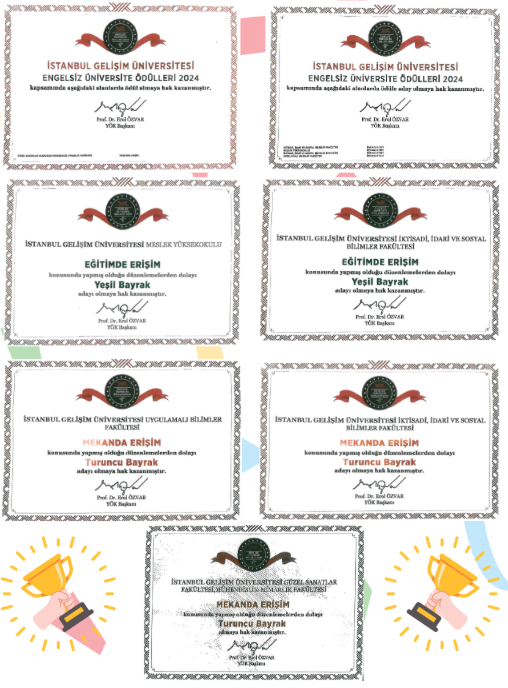
Barrier-Free University Awards (2024)
IGU achieved significant success in 2024 through its accessibility-focused initiatives under the Barrier-Free University Flag Awards. The program aims to enhance the accessibility of spaces, educational opportunities, and socio-cultural activities for individuals with disabilities, while promoting inclusivity across higher education.
As a result of the 2024 evaluations:
- The J Block Tower Campus, which houses the Faculty of Fine Arts (GSF) and the Faculty of Engineering and Architecture (MMF), received the “Orange Flag” in the Physical Accessibility category.
- The Faculty of Economics, Administrative and Social Sciences (İİSBF) earned the “Orange Flag” nomination in the Physical Accessibility category and the “Green Flag” nomination in the Educational Accessibility category.
- The Istanbul Gelisim Vocational School (İGMYO) was nominated for the “Green Flag” in the Educational Accessibility category.
- The Faculty of Applied Sciences (UBF) was nominated for the “Orange Flag” in the Physical Accessibility category.
Barrier-Free University Awards (2024)
Accessibility Arrangements on Campus
At IGU, numerous arrangements have been completed to ensure the equal and independent participation of individuals with disabilities in campus life. In accordance with the relevant provisions of Law No. 5378 on Persons with Disabilities, all necessary procedures for physical accessibility have been planned and initiated across all buildings. In addition, the requirements outlined in the Zoning Law No. 3194 and related regulations have been implemented, taking into account national accessibility standards such as TS 9111 (Accessibility requirements in buildings for persons with disabilities and limited mobility) and TS ISO 23599–13536 (Tactile walking surface indicators for persons with visual impairments).
Some of the implemented accessibility practices are summarized below:
Elevators: Accessible elevators for staff, students, and visitors with disabilities are available in all buildings. Elevator panels include Braille-marked buttons for visually impaired users (notably in Blocks A and F).
Building Entrances: All buildings feature flat entrances adjacent to turnstiles for wheelchair users, and ramps are installed in areas with level differences.
Library Access: Each block’s library is accessible via elevators with doorways of sufficient width. Library staff assist users in retrieving books from upper shelves when needed.
Emergency Systems: Visual alarm systems are installed for hearing-impaired individuals to ensure safety during emergencies.
Accessible Restrooms: Dedicated accessible restrooms are available in Blocks E, K, H, J, I, and G.
Conference Halls: Portable ramps are provided to ensure stage access for individuals with physical disabilities; these are placed before events as needed.
Exam Accommodations: Exams for students with disabilities are conducted in separate rooms under supervision; for visually impaired students, large-print exam papers are provided.
Social Areas: Accessibility has been largely achieved in cafeterias, dining halls, and other social spaces, ensuring equal participation.
Participatory Approach: Feedback from students with disabilities is regularly collected, and awareness-raising events are organized based on their experiences and needs.
Staff with Disabilities: When assigning duties, the health conditions of employees are carefully taken into consideration to ensure a supportive and inclusive work environment.
These arrangements reflect IGU’s comprehensive approach to accessibility—one that extends beyond physical spaces to include education, social participation, and professional life. This holistic perspective demonstrates the university’s strong commitment to fostering an equitable and inclusive campus for all members of its community.
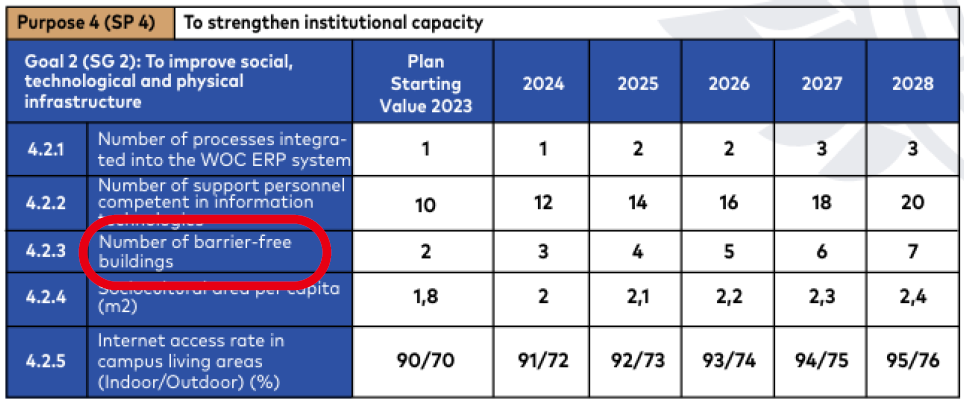
Within the 2024–2028 Strategic Plan, under the objective “Strengthening Institutional Capacity,” the goal “Enhancing Social, Technological, and Physical Infrastructure” includes increasing the number of accessible buildings as a key strategic indicator. The plan outlines that the number of accessible buildings, which was two in 2023, will be gradually increased to seven by 2028.
This approach demonstrates that IGU follows a development-oriented and measurable policy on accessibility, emphasizing continuous improvement rather than one-time compliance. Moreover, the integration of this target into the official strategic plan indicates that accessibility is not merely a declaration of goodwill but a formally monitored and institutionalized objective.
The visual below presents the indicators associated with Objective 4 (SA 4): Strengthening Institutional Capacity, as defined in the 2024–2028 Strategic Plan.